
Medical writing is an exciting and varied career choice. But like any career, it’s not right for everyone. You might not know whether it’s right for you until you’ve actually tried out the role.
I know of many talented and dedicated individuals who’ve decided that medical writing is just not the right long-term career for them. The good news is that they’ve all gone on to enjoy successful careers in other fields.
So, what to do if medical writing is not the career you dreamed it would be?
Take Charlie. Charlie was a talented writer who came straight from finishing her PhD. She had a great understanding of science, exceptional writing skills, and was incredibly friendly and helpful. All in all she was a great member of the agency, and a great writer.
As time went by, it was clear that Charlie was not enjoying life as a medical writer. She struggled with demanding clients, and time management. She got into a cycle of working long hours, feeling overwhelmed, and producing work below required standards. At the root of the problem, Charlie lacked purpose. She simply didn’t love writing for pharma enough to motivate her through the tough times.
I often talk about the writer’s Strengths Triangle as the key to long-term career satisfaction. Charlie’s story illustrates the concept well, because her triangle was out of balance. She had clear Strengths as a writer, and these Strengths aligned with the client’s Needs. Unfortunately, the Preferences (also known as Values) part of the triangle was out of balance, because the type of work Charlie was good at, and that the clients asked for, was not what she enjoyed.
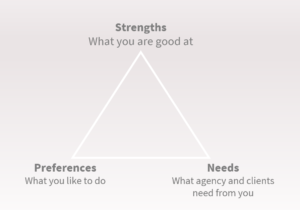
Eventually Charlie handed in her notice. While this was difficult for her colleagues, this story has a happy ending. Charlie had been exploring opportunities beyond medical communications, and had decided to transition into a communications role at a healthcare charity. She could utilise many skills she’d learned as a writer – simplifying complex scientific data, writing for patients, communicating with many different internal and external stakeholders. The transition into a different industry gave Charlie the purpose she so badly needed to motivate her every day. Her Strengths Triangle was re-aligned. By recognising her own strengths and values, Charlie used medical writing as a stepping stone into a different career that she now love and thrives in.
So, what to do if your Strengths Triangle is out of balance?
- Before you decide to make a move, take time to identify the REAL problem. Do your current struggles stem from medical writing itself, the agency environment, or perhaps the particular organisation or team you work for?
- Make sure to fully explore your role and seek out opportunities to try different things. If you’re not enjoying manuscript work, could you be more suited to creative or commercial projects? Perhaps a different agency could help you develop a different set of skills, still within medical writing?
- Consider your strengths and development needs, and how these could be applied differently in your role. Turn the conversation around and ask: What are my strengths? When have I exceeded expectations, and how can I do that again?
- Be open about your concerns with a colleague and/or your manager, who may help you find a way around your current difficulties.
- Consider working with a qualified coach, who will help you identify career goals, barriers and ways to break through them.
- Finally, if you’re sure that a career transition is the right next step for you, discuss it with your manager so you can plan for a smooth transition out of the agency.
If it is the right time to move on from medical writing, rest assured that you’ve gained valuable transferable skills that will serve you well in many other career paths. Take the positives from your experience, and use them to fuel the next steps that are right for you.


